
The aviation industry is entering a new era defined by rapid technological advancement. Aircraft are becoming more automated, more connected, and increasingly capable of operating within complex, high-density airspace environments. From advanced avionics to autonomous flight systems and electric vertical takeoff and landing (eVTOL) aircraft, innovation is accelerating across every corner of aerospace.
At the same time, safety remains aviation’s guiding principle.
Industry leaders are increasingly focused on modernizing the broader aviation ecosystem to support these advancements. Discussions across the sector highlight the need for upgrades to air traffic management systems (ATC). The goal is to better support modern aircraft capabilities and accommodate growing traffic volumes, as well as the exponential growth in drones and other forms of Advanced Air Mobility (AAM).
Today’s aircraft, including these new innovative forms, are increasingly being equipped with sophisticated navigation, automation, and communications technologies, but the infrastructure managing them still relies heavily on systems developed decades ago.
Honeywell recently published an article that speaks to this imbalance clearly.
The aviation community is working to close this gap. Modernization efforts are underway to build a more resilient and scalable airspace system capable of safely managing increasing traffic levels and emerging aircraft technologies. These initiatives are essential to aviation’s future.
However, while the conversation often focuses on large-scale systems like airspace modernization and next-generation avionics, it is equally important to ensure the components within these systems also contribute to aircraft safety every day.
A Holistic Approach to Aircraft Safety
In aviation, safety is rarely achieved through a single breakthrough technology. Instead, it results from the reliability of thousands of individual systems and components working together. Ultimately, safety will depend on a comprehensive approach that addresses every level of the system.
Large-scale initiatives—such as new ATC systems—are essential for accommodating future growth and maintaining safety. But equally important are the engineering decisions made within the aircraft itself. Aircraft have thousands of qualified components. Each component contributes to the aircraft's reliability because safety comes from all the components and systems working together.
EWIS Safety: Protecting Aircraft Wiring Systems
One area where this is particularly important is the Electrical Wiring Interconnection System (EWIS). The EWIS is the aircraft’s nervous system.
Modern aircraft rely on extensive wiring networks to distribute electrical power and transmit signals between avionics, sensors, mission systems, flight controls, and communication equipment. These wiring harnesses run throughout the aircraft, often passing through structural frames and bulkheads across the fuselage, wings, and equipment bays.
Protecting these wiring systems is critical for maintaining both aircraft safety and operational reliability.
Common Threat: Wire Chafe
One of the most common threats to aircraft wiring is chafe. Chafe happens when wires rub against structural edges or components during normal aircraft operation. Abrasion can wear away insulation, potentially leading to signal degradation, electrical faults, arcing, or even fire.
Operational experience shows that wiring damage is a frequent contributor to aircraft downtime. In many cases, aircraft placed in Aircraft on Ground (AOG) or Non-Operational Ready Status (NORS) are grounded because “discrepancies” are detected that affect electrical signals or power distribution caused by relatively minor wire chafing issues.
For aerospace engineers and maintenance organizations (MROs), this highlights that small components can have a major impact on aircraft safety and readiness, not to mention lifecycle costs.
Grommet Edging is Needed to Protect the EWIS
Whenever wiring harnesses pass through structural penetrations in aircraft panels or frames, protective edging is required to prevent contact between the wiring insulation and sharp metal edges.
For decades, nylon grommets conforming to MS21266 standards have been used for this purpose. The challenge is that nylon requires an adhesive to work. This was once considered state-of-the-art, but as a manufacturing practice, it is increasingly seen as old-fashioned.
Installing traditional glued nylon grommets typically involves several steps:
- Edge abrasion and cleaning to prepare surfaces for bonding
- Application of adhesive to secure the grommet
- Temporary taping or fixturing while the adhesive cures
- Removal of excess adhesive using solvents and cleanup materials
Adhesives are required to keep these nylon grommets in place because the material itself does not provide any mechanical retention. Without adhesive, they would essentially just sit on the edge.
When the adhesive is used, over time, the bonding tends to degrade under operational stresses like temperature changes and vibration, creating disbonding and the need for repairs.
For aircraft manufacturers and maintenance teams, these multi-step installations introduce additional labor time, process complexity, and variability in application.
Spring-Fast® Grommet Edging: A Modern Solution for Aircraft Wiring Protection
To address these challenges, newer technologies have been developed that simplify installation while improving long-term reliability.
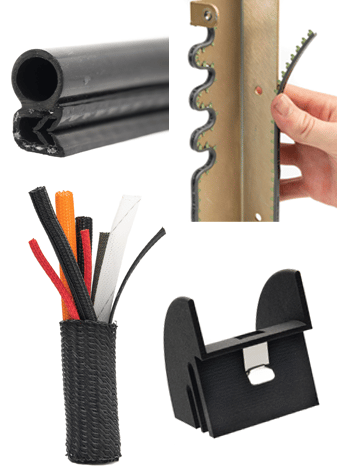
One such technology is Spring-Fast® grommet edging. Spring-Fast is a qualified MilSpec product that provides a better alternative to the old nylon and adhesive grommets.


Unlike nylon grommets, Spring-Fast snaps onto the edge with simple finger pressure. This eliminates the need for adhesives, curing time, or solvent cleanup. It saves at least 49% of installation costs, improves productivity by 9.5X because far fewer steps are needed to install it, and has had no failures in 30+ years.
The design incorporates a polymer-coated ultra-thin CRES substrate with opposing “castle” features that grip the panel edge and hold the grommet securely in place without adhesive. This edge retention has been proven not just in shock & vibration testing but also in the field on multiple commercial and military applications. Spring-Fast has no known failures in over 30 years.
Advantages For Engineers and Production Teams.
Faster Installation and Assembly Efficiency
- Spring-Fast dramatically reduces installation steps compared to nylon grommets and adhesive.
- Technicians can immediately route wiring harnesses without any cure time – simplifying production and maintenance environments.
- One-hand finger-pressure application lets techs place Spring-Fast on tough, hard-to-reach recesses.
Significant Labor Cost Reduction
- The installation savings across hundreds of penetrations are substantial. In large platforms, it can run into millions of dollars
- DTi's comparative analysis shows costs drop from $54.62 per nylon grommet to $19.93 using Spring-Fast, an incredible 63.5% lower installation cost. (Based on a $130/hr WRAP rate.)
Reduced Foreign Object Debris (FOD) Risk
- Spring-Fast requires far fewer materials/tools to be carried onto the aircraft during installs.
- This reduces the risk of foreign object debris (FOD)—an important consideration in aerospace.
Proven Aerospace Performance
- Spring-Fast grommet edging has proven strong edge retention even under 20/20/20 G static load tests.
- This is true even when castles are removed to provide clearance around hardware such as Adel clamps.
Learn more about how Spring-Fast® grommet edging here
Read our full business case here
Of note for the aero, defense, and security sectors, DTi has achieved an outstanding JOSCAR score of 74.17, an important benchmark recognized across those sectors. This independent assessment reflects our commitment to the highest standards of quality, compliance, and operational excellence, giving customers added confidence when selecting Device Technologies as a trusted supplier.