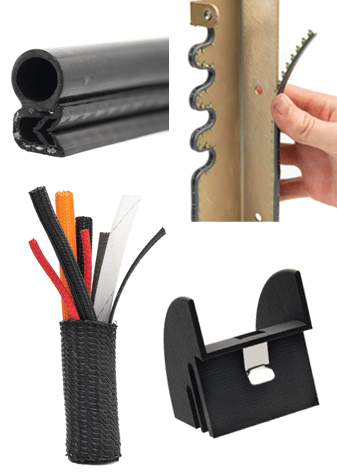

For an aerospace design engineer, specifying grommet edge protection may seem like a relatively small decision. Compared with propulsion systems, avionics, structural components, or flight controls, grommet edging is inexpensive and uncomplicated.
But its job is important: to keep wiring, cables, & hoses from contacting potentially damaging metal edges throughout the service life of the aircraft.
That last phrase—throughout the service life of the aircraft—is important.
These photographs show MS21266 nylon grommet edging installed on an operational aircraft that was in for some MRO work to replace old grommets and implement new wiring.
It needed the MRO work badly as the nylon grommets had deteriorated badly and would not protect the wiring.
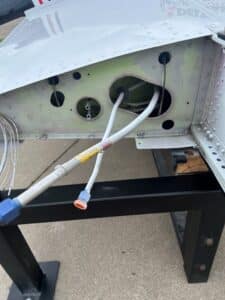
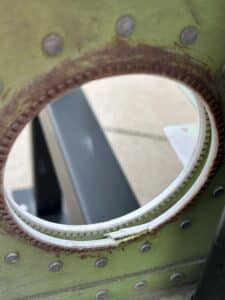
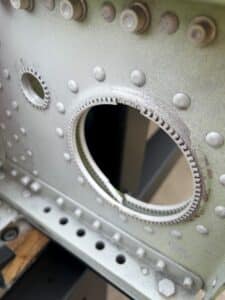
Damage is seen on several sections of the edging. In places, it appears broken or separated. Other sections no longer appear to follow the metal edge uniformly. How well do you think this will protect the wiring?
Grommet edging’s #1 job is to protect the wiring from abrasive metal edges. A small break in that protection can potentially create a point of contact. And aircraft do not provide a benign environment for wiring.
Is service life taken into account when specifying wire protection?
An aircraft can subject components to vibration, temperature changes, mechanical movement, fluids, maintenance activity and thousands of operating cycles.
The protection system therefore needs to do more than simply fit the edge when the aircraft leaves production. It needs longevity and engineers need to be sure it will be reliable.
Traditional MS21266 nylon grommet edging relies on adhesive for edge retention. This creates a system consisting of two elements—the nylon edging and the adhesive and it also adds another process variable.
Techs have to use a long, costly, multi-step gluing process that includes a non-standard component—how much glue do we actually use?
The immediate concern is the system the grommet protects, not so much its breakdown. If the edging is damaged or shifts out of place, the wiring may be damaged.
Aircraft vibration makes that a high risk. A wire doesn't have to make one dramatic movement across a sharp edge to sustain damage. Repeated small movements can create abrasion and chafing over time.
Damage to insulation can potentially lead to electrical faults, intermittent signals, data issues, short circuits or even fire.
An aerospace engineer should treat retention as part of the protection function, not merely an installation issue.
There is a Process Manufacturing Question
Traditional nylon edging and adhesive create a manufacturing process issue because workers must position the edging, apply the adhesive, and complete the installation according to the specified process. Adhesives introduce additional material (and potential FOD), application steps, process controls, and curing or handling considerations.
Multiply those steps across hundreds of edges and what looks like a minor component can become a meaningful manufacturing time sink.
Why use adhesive? Spring-Fast® can provide retention without it.
Spring-Fast takes a different engineering approach to the edge retention problem. It is the best grommet edging you can find.
An encapsulated spring-steel core grips the edge, and installers fit it with finger pressure and no adhesive. This changes the design proposition from nylon edging + adhesive + multi-step application process to a mechanically retained edge-protection component.
That difference can have consequences for both manufacturing and life-cycle performance.
Based on DTi's client installation studies, Spring-Fast can provide at least 49% installed-cost savings compared with traditional nylon grommet edging and adhesive, while increasing installation productivity by approximately 9.5×. We are highly confident of the “at least 49%” as the costs were based on a shop labor rate of $32/hour.
For weight-sensitive aerospace applications, Spring-Fast is approximately 10% lighter than the nylon-and-adhesive alternative, and even more depending on how much adhesive is normally applied.
Across an aircraft with hundreds of penetrations and edges, the savings in both time and money become significant.
The Best Grommet Edging- Spring-Fast.
When selecting something as apparently simple as grommet edging, engineers should therefore look beyond initial material properties and unit purchase price. Retention method, vibration, installation consistency, manufacturing labor, weight, inspection, maintenance, and long-term protection all deserve consideration.
Because the real question isn't simply whether the grommet edging protects the wire when it is installed, but will it protect the wire in the months and years ahead?
Find out more about Spring-Fast here
Request free samples to see for yourself.
For more about grommet choices see an overview here