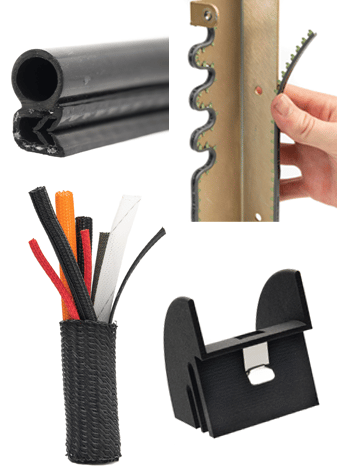

In industrial equipment design, small components often have a vital role.
Grommet edging is one of those small components. It may not dominate the bill of materials, yet it plays a critical role in protecting wire bundles, cable assemblies, hoses, and sensitive components from the sharp or abrasive edges of sheet metal panels, bulkheads, enclosures, brackets, and cutouts.
When a wire harness passes through a stamped, punched, laser-cut, or machined opening, the panel edge can become a point of failure. Vibration, movement, cable weight, and thermal shifts can cause insulation to rub against edges.
The result can be chafing, exposed conductors, intermittent signals, equipment malfunction, electrical hazards, unplanned maintenance, or failure. For design engineers, edge protection is therefore not just a finishing detail. It is part of their reliability strategy.
Nylon Grommets- The Old Way
For decades, nylon grommets have been used to address this problem. Nylon offers useful properties: it is lightweight, tough, abrasion-resistant, and has a low-friction surface that helps protect insulation. Molded or extruded nylon edging can work well in relatively simple applications, particularly for long, straight panel edges or in indoor assemblies with moderate temperature exposure.
Some big companies have been supplying the traditional solid plastic (nylon/polyethylene) “caterpillar” strips, like Panduit and Hellermann Tyton.
However, traditional bonded nylon edging also introduces practical engineering and manufacturing tradeoffs. Nylon grommets generally do not grip panel edges because they provide no inherent edge retention. As a result, adhesives are required to keep the grommet in place.
That adhesive dependency is where many hidden costs begin. Nylon grommet installation generally requires prepping the surface by abrasion, VOC solvent cleaning, gloves to prevent contamination, tape or clamps to hold the grommet while adhesive cures, and cure periods of up to 12 hours and potential hazardous-material handling. Each step adds labor, work-in-process delay, quality variation, and rework risk.
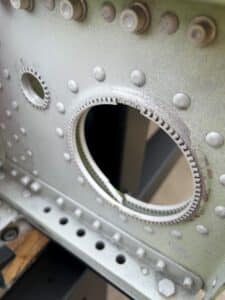
Nylon has some material characteristics that can affect performance. It is hygroscopic, meaning it can absorb moisture. In humid environments, the material can soften or weaken; conversely, in dry environments, nylon tends to dry out and become brittle. The adhesive itself is a weak link as it suffers the same stresses as the grommet.
How the product is made and stored also matters. If the nylon is coiled, it tends to retain coil set, which means it resists flush installation on straight edges. On tight-radius corners, straight nylon lengths may resist bending to form a fit to the radius. These factors can make nylon difficult to install consistently across the varied edge conditions found in real-world industrial equipment.
Encapsulated Metal Grommets- The New Way
Encapsulated metal substrate grommet edging was developed to address these limitations. Instead of relying primarily on adhesive bonding, it uses a metal substrate encapsulated in a protective polymeric coating.
A metal substrate provides mechanical retention, while the polymer encapsulation protects cables from abrasion and supports insulation, flame, corrosion, and environmental performance requirements.
Why is This Method Better?
The key difference is how it is applied. Traditional bonded nylon edging depends on adhesive to compensate for its low level of edge retention. Encapsulated spring-metal edging uses mechanical clamping force. It is designed to press into the edge and provide edge retention. No adhesive. No cure time. No waiting around for the adhesive to cure before starting the next operation.
For design engineers, this changes the evaluation from component price to total installed cost. Encapsulated metal grommets can reduce total installed costs by at least 49% compared with bonded nylon. This is driven by a 9.5x installation workflow efficiency gain by eliminating all the adhesive steps.
Encapsulated metal does not relax, which ensures that it passes shock and vibration tests that are critical for not just aircraft and rail, but also for any equipment that has vibration.
Performance Comparison
The performance benefits are just as important as the manufacturing benefits. In assemblies exposed to vibration, shock, handling, transportation, or thermal cycling, retention is critically important.
Nylon can experience stress relaxation over time, reducing its ability to maintain grip. By contrast, a stainless steel core maintains clamping force almost indefinitely. That makes encapsulated metal grommet edging especially valuable in equipment where wiring could be exposed to sharp edges and vibration.

Flexibility is another important design consideration. Industrial panels rarely consist only of long, straight edges. Engineers often need to protect circular or rectangular pass-throughs, tight corners, compound shapes, service access panels, enclosure cutouts, and irregular geometries.
Nylon can be difficult to apply over rough or burred metal and may require multiple installation attempts. Encapsulated metal grommet edging with segmented “castles” or angled teeth is designed to bend around inside and outside corners while maintaining grip, even when edge conditions vary.
Summary Table: Metal Core vs. Plastic Competitors
| Encapsulated Metal Substrate | Nylon/PE | |
| Primary Providers | Device Technologies Inc | Panduit, Hellermann Tyton |
| Edge Retention | Mechanical Clamping via steel substrate | Adhesive |
| Install Ease | Instant (Snap-on) | Slow (Requires glue + cure time) |
| Level of Edge Retention | High | Lower over time |
| Primary Use Case | Aerospace, Rail, Vibration applications | General Electronics |
Spring-Fast #1 in Encapsulated Metal Grommets
Spring-Fast® grommet edging has earned this reputation across multiple industries. It has been used widely in Aerospace (FAA approved), Military (MilSpec), Rail applications, Auto applications, DoD Tactical Vehicles, and IT Server Enclosures to name a few.
The encapsulated metal substrate provides self-fastening edge protection for demanding industrial applications. It installs with finger pressure, grips securely without adhesives, conforms to most panel shapes, and reduces the labor and variability associated with traditional bonded nylon grommets.
End result? A cleaner design and production path: fewer process steps, less waiting, less rework, and more reliable retention. Eliminating adhesives can also reduce exposure to VOCs and hazardous chemicals on the factory floor, simplifying handling and supporting safer, more efficient assembly operations.
Conclusion
For design engineers comparing grommet edging options, the question should not be limited to “Which material protects the edge?” A better question is: “Which solution protects the edge reliably, installs consistently, performs in practically any operating environment, and reduces total installed cost?”
The answer is clearly Spring-Fast.
Nylon grommets still have a place in straightforward, low-demand applications. But for industrial equipment where uptime, vibration resistance, assembly speed, and long-term retention matter, encapsulated metal grommet edging offers a much stronger engineering case. The numbers make sense too, as it will save at least 49% of your install costs and boost productivity by 9.5X.
To evaluate the difference in your own application, request Spring-Fast samples and test them against your current nylon grommet installation. Compare fit, installation time, retention, bend performance, and process cost. We are confident that the results will reveal that the lowest-risk edge protection choice is also the one that simplifies production and saves money.
See for yourself. Order free samples here
Find out more about the types of grommets here