The Advanced Air Mobility (AAM) or the Urban Air Mobility (UAM) market – formerly known as the “air-taxi” market – is predicted to grow dramatically by 2030 to $80bn per research firm Spherical Insights – up from $4.9bn in 2023. That equates to almost an impressive compound annual growth rate (CAGR) of 50% per year.

That growth is predicated on several key milestones that must happen before AAMs become normal in the US:
- The development of a network of vertiports that is integrated into the existing travel infrastructure
- The development of an advanced air traffic control (ATC) network is needed to keep the expected high volume of low-flying aircraft safe & conflict-free. Current ATC systems are designed for a few large aircraft, not fleets of smaller AAMs.
- Regulatory approval will take time.
- Lastly, consumers will need to feel safe before they adopt the tech.
This predicted growth is being driven by technological advancements akin to self-driving cars, delivery drones, etc., but underlying the technology is the desire to escape the growing traffic congestion in cities.
Many low-altitude electric vertical take-off and landing aircraft (eVTOL) have been test flown; however, AAM adoption and use will be a process. Small-scale delivery drones to a limited area are already in place. The likely next big step will be to test vertiports in the outskirts of cities before moving into the riskier urban centers.
Progress is happening for the leaders in the field. Joby just completed (June 2025) a series of piloted VTOL flights in Dubai. Archer had the first flight of its Midnight model in Abu Dhabi, and Eve Holding expects to launch its eVTOL services in 2026.
The investment money to make it happen is flowing. Toyota has invested $894m in Joby Aviation. Stellantis has invested $204m in Archer Aviation. United has invested at least $15m in Eve Air Mobility.
Technological Needs for Air Taxis
Air taxis will need to show advancements in many areas.
- Noise Reduction: Quieter propulsion systems, improved aerodynamics, and noise-reducing materials.
- Autonomous Flight: Advanced sensors, AI algorithms, collision avoidance systems.
- Rigorous testing and standardization of software for autonomous systems.
- Advanced Batteries: for range and payload capacity plus energy density, & charging speed.
This technology stack will require wiring to transfer power and data. The Electrical Wiring Interconnect System (EWIS) is the nervous system of the aircraft. It is a critical component of any aircraft, including AAMs. It does no good to have state-of-the-art avionics if the wiring system cannot supply it with the data or power it needs. A “simple” wire issue that creates equipment “discrepancies” can make any system function poorly or not at all.
The EWIS in AAM applications will have to meet almost the same challenges faced by larger, higher-flying commercial aircraft. Notably, shock, vibration, fluid exposure, temperature changes, plus the stress from flight and G forces.
Protecting the EWIS is critical for these AAMs, as wiring can suffer chafing, which can lead to arcing and sparking.
The Cause OF Wiring Chafe
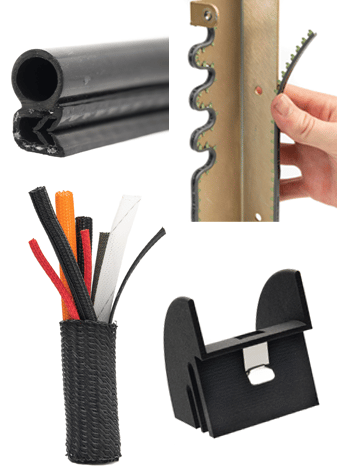
Chafe happens when wiring crosses a sharp edge. The wiring has to be protected by applying grommet edging.
Grommet edging is a small component in aircraft, but its impact is far larger than its size.
The old way to do this was to apply a stiff nylon grommet to the edge and keep it on the edge with an adhesive. It is a slow, costly way of protecting the EWIS.
Joby chose Spring-Fast® – A Better, Simpler Grommet Edging
Spring-Fast is specified for and is in use on the Joby AAM aircraft.
DTi has a long history of success in both commercial and military aviation with Spring-Fast grommet edging.


Spring-Fast Mil-Spec Grommet Edging installs without adhesive. The simplicity and speed of application without adhesive create significant savings and operational benefits vs. the old legacy nylon grommet.
- It saves OEMs at least 49% of their grommet edging install costs.
- It increases efficiency by a factor of 9.5X
- Has had no failures in 30+ years.
Key Features
- Spring-Fast has a high-performance polymer coating on an ultra-thin CRES substrate
- Spring-Fast snaps into place with finger pressure.
- Opposing finger-like castles exert a compression force for edge retention without adhesive.
- Static load tested to 20/20/20 G – even when 4 castles are removed.
- Reduced Health and Safety issues as no HazMat/VOCs (adhesives or solvents) are needed.
- Weighs ~10% less than a nylon grommet and its required adhesive.
See for yourself why Joby is using Spring-Fast.
Order free samples here